

Content & Research
HUB
Know more. Act together.
Stories, research and tools on social justice and environmental issues. Find what you need, share what matters, create change.

Civil Society Capacity
Upload and share resources with the movement.

Find what matters
Search, filter and discover content across a wide range of issues.

Amplify voices
Highlight campaigns and stories driving real change.

Build solidarity
Connect with organisations and collectives working for justice.
Search Keywords
Filter By

Resources
#20 Mobilize Newsletter
- Civic Participation, Civil Society, Climate & Environmental Justice, Climate Change, Democracy, Governance & Civic Participation, Economic Empowerment, Economic Justice, Environmental Health and Air Pollution, Fossil Fuels & Extractivism, Gender, Sexuality & Care Justice, Government Accountability, Health Justice, Housing and Informal Settlements, Human Rights & Social Justice, Just Transition, Justice Campaigns, Land, Housing & Indigenous Justice, Local Government, Municipality budgets and Finance, Poverty & Inequality, Renewable Energy, Service Delivery, Social Protection & Grants, Spatial Justice, Urban Development, Voting, Women's Rights and Feminism
- Newsletter, Resources
#20 Mobilize Newsletter
August 11, 2026
#20 Mobilize Newsletter
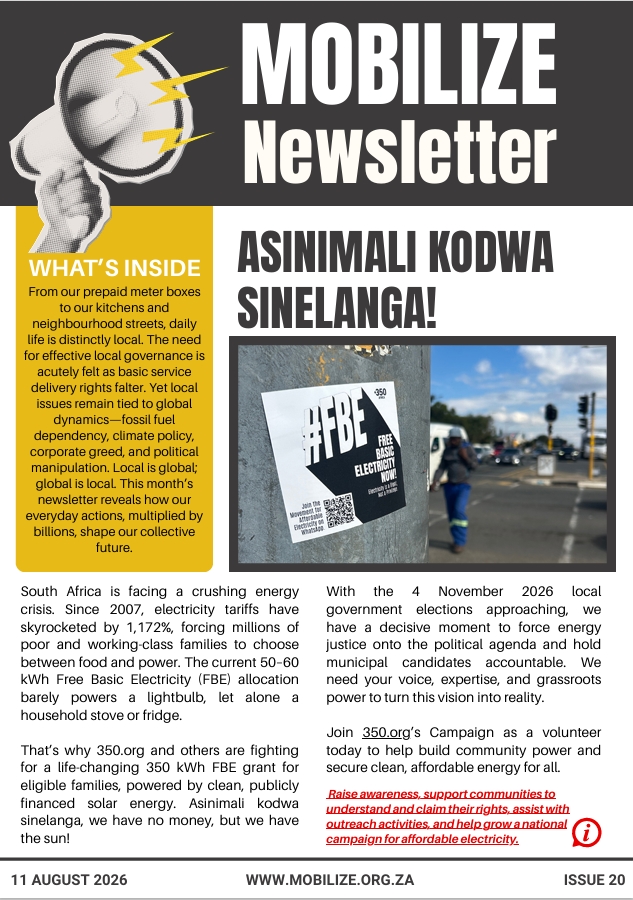
From our prepaid meter boxes to our kitchens and neighbourhood streets, daily life is distinctly local. The need for effective local governance is acutely felt as basic service delivery rights falter. Yet local issues remain tied to global dynamics—fossil fuel dependency, climate policy, corporate greed, and political manipulation. Local is global; global is local. This month’s newsletter reveals how our everyday actions, multiplied by billions, shape our collective future.
Source : Mobilize Website
NewsletterResources
Civic ParticipationCivil SocietyClimate & Environmental JusticeClimate ChangeDemocracy, Governance & Civic ParticipationEconomic EmpowermentEconomic JusticeEnvironmental Health and Air PollutionFossil Fuels & ExtractivismGender, Sexuality & Care JusticeGovernment AccountabilityHealth JusticeHousing and Informal SettlementsHuman Rights & Social JusticeJust TransitionJustice CampaignsLand, Housing & Indigenous JusticeLocal GovernmentMunicipality budgets and FinancePoverty & InequalityRenewable EnergyService DeliverySocial Protection & GrantsSpatial JusticeUrban DevelopmentVotingWomen's Rights and Feminism


#19 Mobilize Newsletter
- Activism, Anti-Corruption, Anti-Racism, Civic Participation, Civil Society, Climate & Environmental Justice, Climate Change, Constitutional Rights, Constitutional Rights, Democracy, Governance & Civic Participation, Economic Justice, Education & Knowledge Justice, Equality, Food Justice & Hunger, Food Security & Sovereignty, Fossil Fuels & Extractivism, Government Accountability, Human Rights, Human Rights & Social Justice, Hunger & Malnutrition, Indigenous Rights, Informal Workers, International Law, Just Transition, Justice Campaigns, Labour & Workers' Rights, Land Defenders, Land, Housing & Indigenous Justice, Migrant Labour, Migrant Workers, Migration & Refugee Justice, Palestine, Peace, Conflict & International Solidarity, Poverty & Inequality, Renewable Energy, Service Delivery, Student Activism, Trade Unions, Waste & Circular Economy, Xenophobia and Afrophobia, Youth Leadership
- Newsletter, Resources
#19 Mobilize Newsletter
July 10, 2026
#19 Mobilize Newsletter
This Mandela Month we are confronted by what the experts call the Polycrisis. Intersecting climate, social, and economic collapse pull at us from all directions: xenophobia, climate catastrophe, displacement, war, trash, and the relentless fossil industry. The scale of the work ahead of us requires more than 67 minutes of service. It requires mass movements and a generation of dedication.
Source : Mobilize Website
NewsletterResources
ActivismAnti-CorruptionAnti-RacismCivic ParticipationCivil SocietyClimate & Environmental JusticeClimate ChangeConstitutional RightsConstitutional RightsDemocracy, Governance & Civic ParticipationEconomic JusticeEducation & Knowledge JusticeEqualityFood Justice & HungerFood Security & SovereigntyFossil Fuels & ExtractivismGovernment AccountabilityHuman RightsHuman Rights & Social JusticeHunger & MalnutritionIndigenous RightsInformal WorkersInternational LawJust TransitionJustice CampaignsLabour & Workers' RightsLand DefendersLand, Housing & Indigenous JusticeMigrant LabourMigrant WorkersMigration & Refugee JusticePalestinePeace, Conflict & International SolidarityPoverty & InequalityRenewable EnergyService DeliveryStudent ActivismTrade UnionsWaste & Circular EconomyXenophobia and AfrophobiaYouth Leadership

#18 Mobilize Newsletter
- Activism, Civic Participation, Civil Society, Climate & Environmental Justice, Climate Change, Climate Migration, Democracy, Governance & Civic Participation, Food Justice & Hunger, Food Security & Sovereignty, Fossil Fuels & Extractivism, Government Accountability, Human Rights & Social Justice, Hunger & Malnutrition, Informal Workers, Just Transition, Justice Campaigns, Labour & Workers' Rights, Migrant Labour, Migrant Workers, Migration & Refugee Justice, Mining & Resource Justice, Pollution & Environmental Health, Renewable Energy, Trade Unions, Xenophobia and Afrophobia
- Newsletter, Resources
#18 Mobilize Newsletter
June 8, 2026
#18 Mobilize Newsletter
From the gates of Glencore to the doorway of Total, behind the curtain at Sasol, and in the battery revolution, this newsletter edition tracks how power, protest, and technology are reshaping the energy landscape. The transition will be brought to life by people organizing for a just and livable future, not corporations protecting profit.
Source : Mobilize Website
NewsletterResources
ActivismCivic ParticipationCivil SocietyClimate & Environmental JusticeClimate ChangeClimate MigrationDemocracy, Governance & Civic ParticipationFood Justice & HungerFood Security & SovereigntyFossil Fuels & ExtractivismGovernment AccountabilityHuman Rights & Social JusticeHunger & MalnutritionInformal WorkersJust TransitionJustice CampaignsLabour & Workers' RightsMigrant LabourMigrant WorkersMigration & Refugee JusticeMining & Resource JusticePollution & Environmental HealthRenewable EnergyTrade UnionsXenophobia and Afrophobia
#16 Mobilize Newsletter
- Access to Healthcare, Activism, Civil Society, Climate & Environmental Justice, Economic Justice, Financial Justice & Reparations, Global Debt & Trade Justice, Health Justice, Human Rights, Human Rights & Social Justice, Human Rights Defenders, Mining & Resource Justice, Peace, Conflict & International Solidarity, War
- Newsletter, Resources
#16 Mobilize Newsletter
April 9, 2026
#16 Mobilize Newsletter
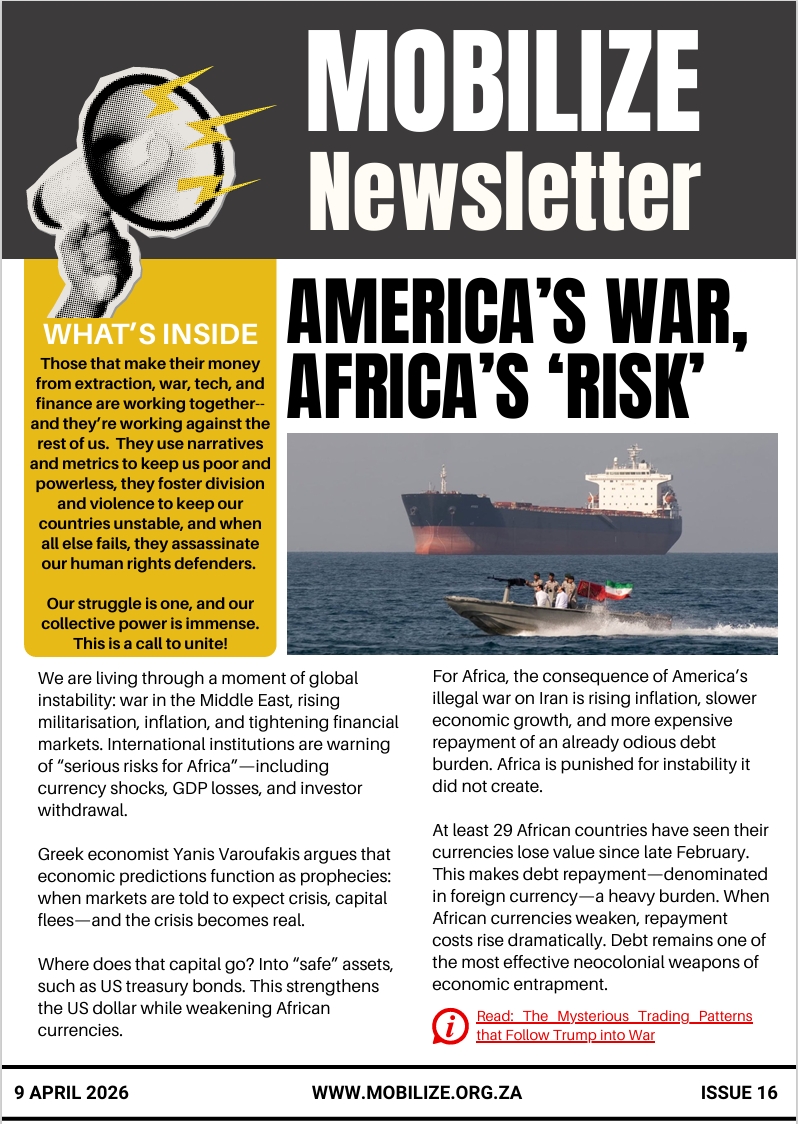
Issue 16 of the Mobilize Newsletter explores how global systems of war, debt, extraction, and economic policy continue to impact Africa, linking topics such as America’s war economy, flawed GDP-driven development models, mining injustice, healthcare access, and the protection of human rights defenders. The newsletter also highlights grassroots activism, community resistance, and upcoming social justice and climate mobilisation events across South Africa and beyond.
Source : Mobilize Website
NewsletterResources
Access to HealthcareActivismCivil SocietyClimate & Environmental JusticeEconomic JusticeFinancial Justice & ReparationsGlobal Debt & Trade JusticeHealth JusticeHuman RightsHuman Rights & Social JusticeHuman Rights DefendersMining & Resource JusticePeace, Conflict & International SolidarityWar
#15 Mobilize Newsletter 13/03/2026
- Activism, Artificial Intelligence, Civil Society, Climate & Environmental Justice, Climate Change, Data Centers and Environmental Risk, Economic Justice, Fossil Fuels & Extractivism, Human Rights & Social Justice, Technology, Media & Digital Justice, Wealth & Corporate Tax Justice
- Newsletter, Resources
#15 Mobilize Newsletter 13/03/2026
March 13, 2026
#15 Mobilize Newsletter 13/03/2026
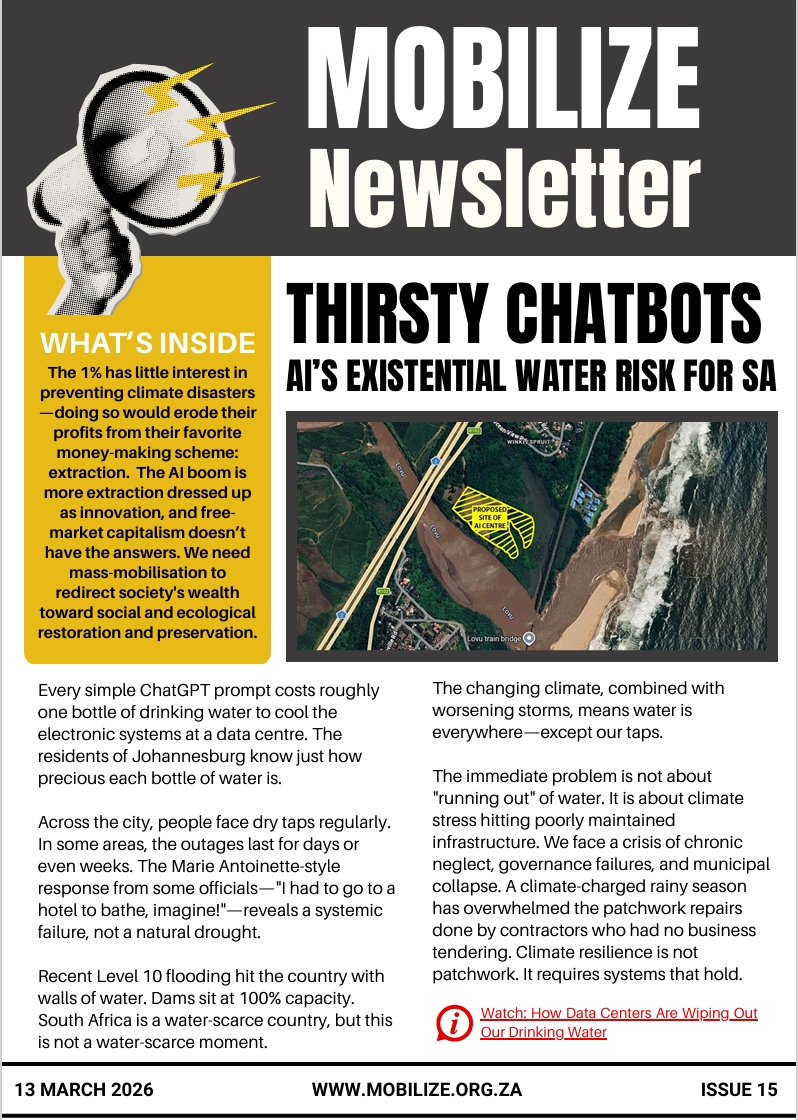
#15 of the Mobilize Newsletter (13 March 2026) covers the lack of interest of the 1% in preventing climate disasters as doing so would erode their profits from the scheme that makes them money – extraction. The issue covers how the AI boom is extraction dressed up as innovation and how we as the people need mass-mobilisation to redirect society’s wealth toward social and ecological restoration and preservation.
Source : Mobilize Website
NewsletterResources
ActivismArtificial IntelligenceCivil SocietyClimate & Environmental JusticeClimate ChangeData Centers and Environmental RiskEconomic JusticeFossil Fuels & ExtractivismHuman Rights & Social JusticeTechnology, Media & Digital JusticeWealth & Corporate Tax Justice
#14 Mobilize Newsletter 20/02/2026
- Climate & Environmental Justice, Democracy, Governance & Civic Participation, Food Justice & Hunger, Government Accountability, Human Rights, Human Rights & Social Justice, Hunger & Malnutrition, Service Delivery, Water Justice & Water Security
- Newsletter, Resources
#14 Mobilize Newsletter 20/02/2026
February 20, 2026
#14 Mobilize Newsletter 20/02/2026
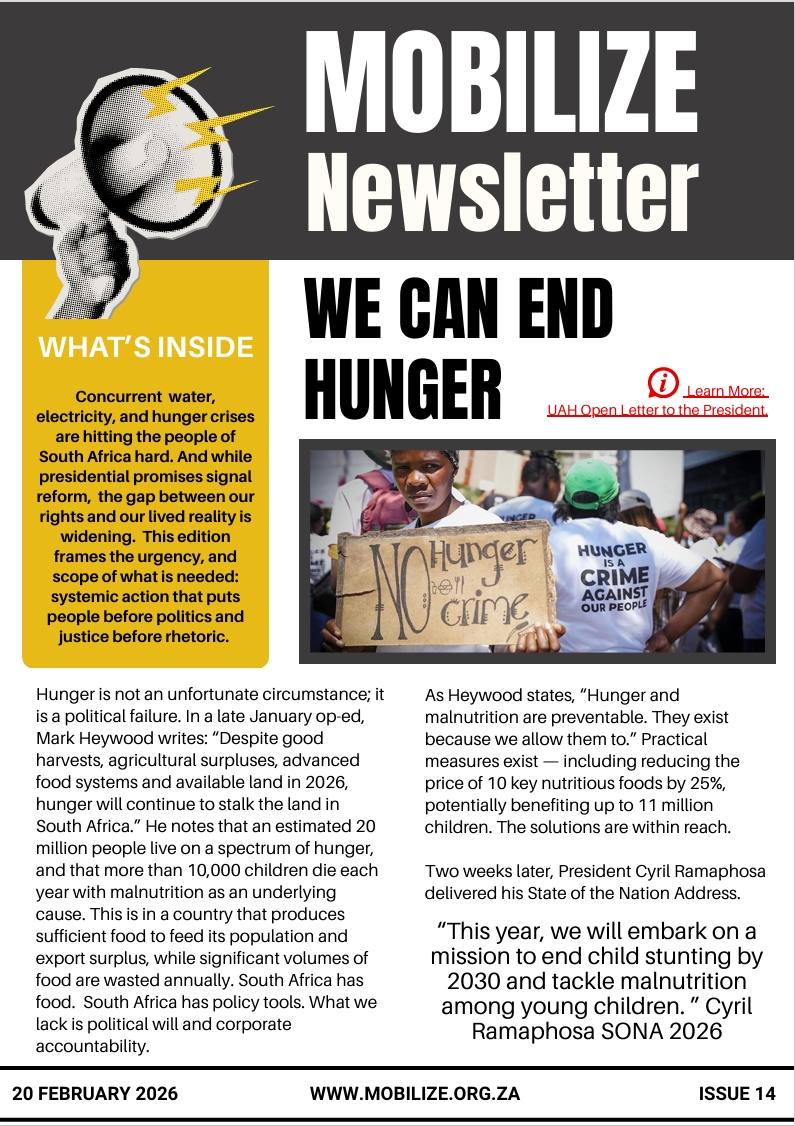
#14 of the Mobilize Newsletter (20 February 2026) looks at how the concurrent water, electricity and hunger crises are negatively impacting the people of South Africa. Whilst presidential promises signal reform, there is a widening gap between our rights and our lived realities as South Africans. The issue frames the urgency and scope of what is needed that being systemic action that puts people before politics and justice before rhetoric.
Source : Mobilize Website
NewsletterResources
Climate & Environmental JusticeDemocracy, Governance & Civic ParticipationFood Justice & HungerGovernment AccountabilityHuman RightsHuman Rights & Social JusticeHunger & MalnutritionService DeliveryWater Justice & Water Security
#13 Mobilize Newsletter 30/01/2026
- Activism, Civic Participation, Climate & Environmental Justice, Climate Change, Democracy, Governance & Civic Participation, Economic Justice, Financial Justice & Reparations, Fossil Fuels & Extractivism, Global Debt & Trade Justice, Poverty & Inequality
- Newsletter, Resources
#13 Mobilize Newsletter 30/01/2026
January 30, 2026
#13 Mobilize Newsletter 30/01/2026
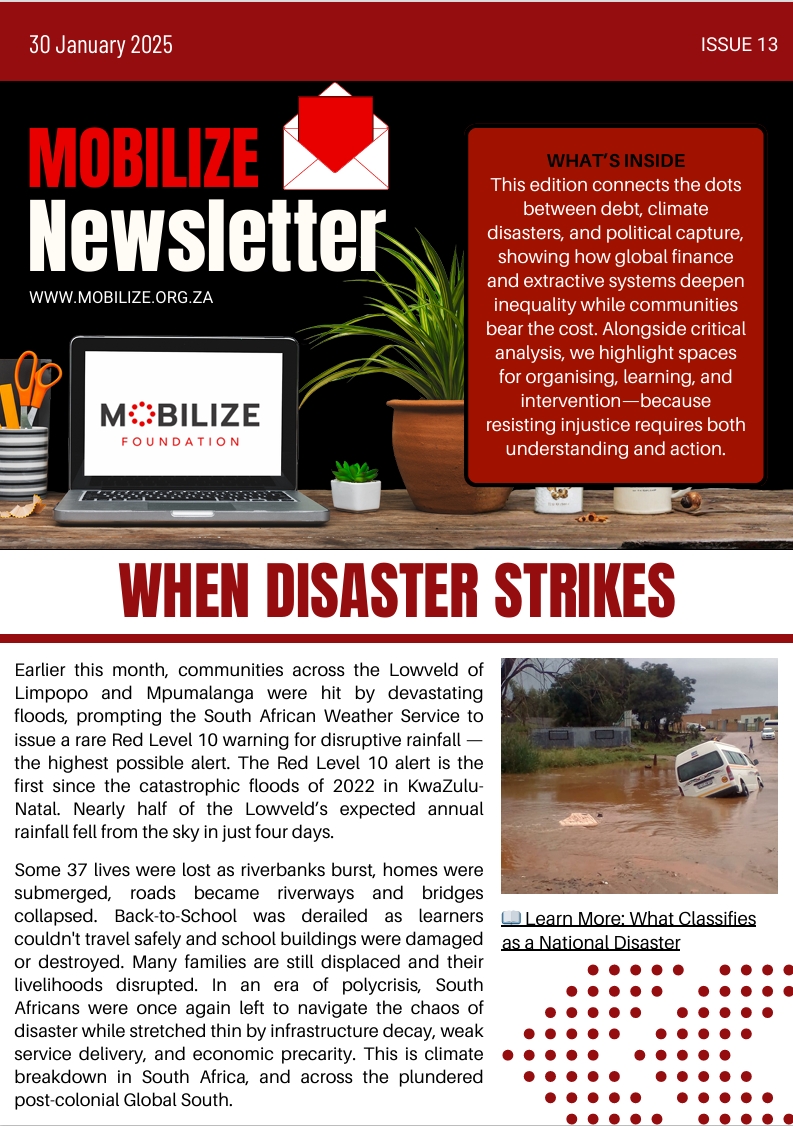
#13 of the Mobilize Newsletter (30 January 2026) connects the dots between debt, climate disasters and political capture. Showing how global finance and extractive systems deepen inequality while communities bear the cost. Alongside critical analysis, the issue highlights spaces for organising, learning and intervention as resisting injustice requires both understanding and action.
Source : Mobilize Website
NewsletterResources
ActivismCivic ParticipationClimate & Environmental JusticeClimate ChangeDemocracy, Governance & Civic ParticipationEconomic JusticeFinancial Justice & ReparationsFossil Fuels & ExtractivismGlobal Debt & Trade JusticePoverty & Inequality
#12 Mobilize Newsletter 11/12/2025
- Civil Society, Democracy, Governance & Civic Participation, Economic Justice, Food Justice & Hunger, Government Accountability, Human Rights & Social Justice, Hunger & Malnutrition, Justice Campaigns, Poverty & Inequality
- Newsletter, Resources
#12 Mobilize Newsletter 11/12/2025
December 11, 2025
#12 Mobilize Newsletter 11/12/2025
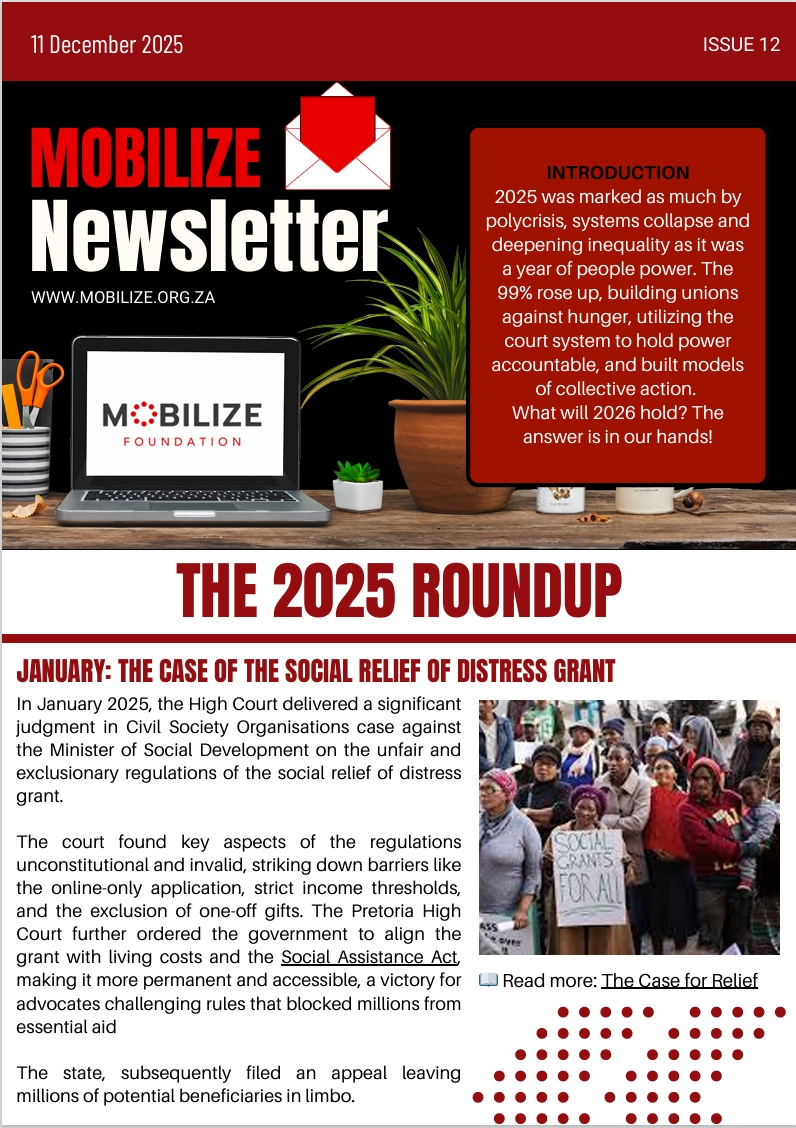
#12 of the Mobilize Newsletter (11 December 2025) provides a roundup of what happened in 2025. The year was marked polycrisis, systems collapse and deepening inequality ,but it was also a year of people power. The 99% rose up building unions against hunger, utilising the court system to hold those in power accountable and built models of collective action.
Source : Mobilize Website
NewsletterResources
Civil SocietyDemocracy, Governance & Civic ParticipationEconomic JusticeFood Justice & HungerGovernment AccountabilityHuman Rights & Social JusticeHunger & MalnutritionJustice CampaignsPoverty & Inequality
#11 Mobilize Newsletter 28/11/2025
- Activism, Biodiversity & Conservation, Civic Participation, Climate & Environmental Justice, Climate Change, Democracy, Governance & Civic Participation, Economic Justice, Financial Justice & Reparations, Food Justice & Hunger, Food Security & Sovereignty
- Newsletter, Resources
#11 Mobilize Newsletter 28/11/2025
November 28, 2025
#11 Mobilize Newsletter 28/11/2025
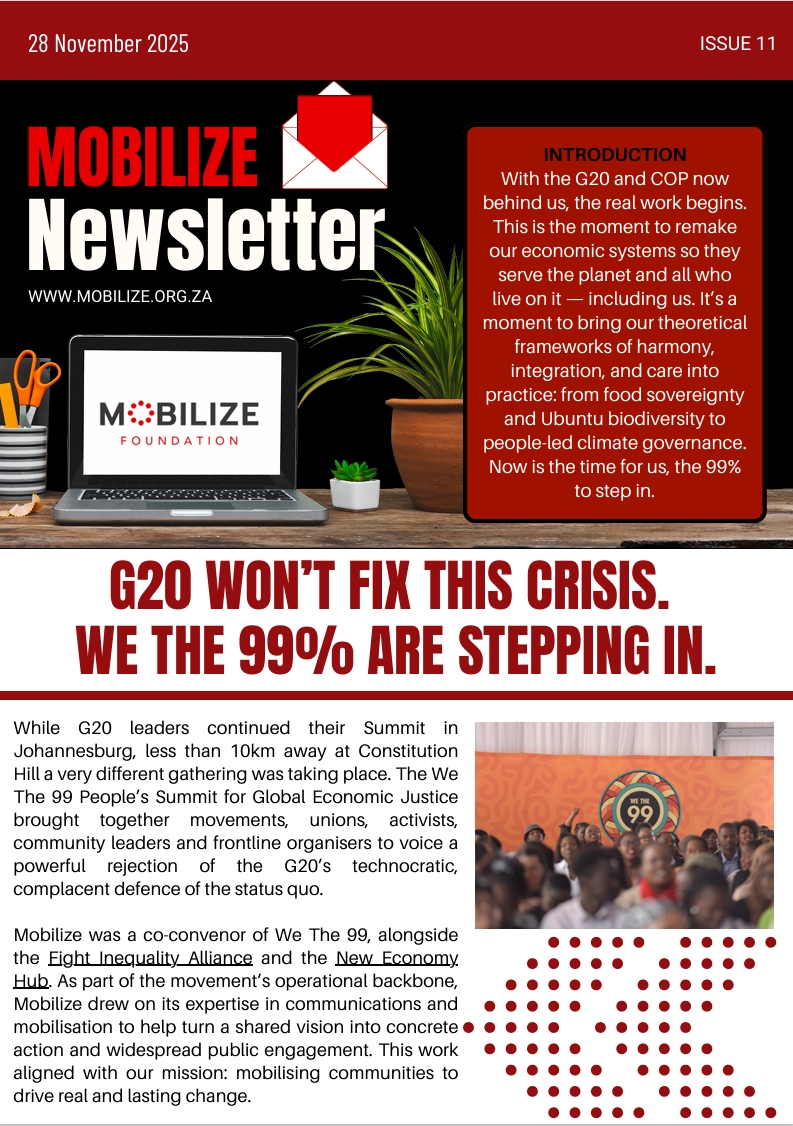
#11 of the Mobilize Newsletter (28 November 2025) explores how the real work begins with the conclusion of the G20 and COP30. It looks at the need to remake our economic systems so that they serve the planet and all who live on it. The need to bring theoretical frameworks of harmony, integration and care into practice. From food sovereignty and Ubuntu biodiversity to people-led climate governance. It is time for the 99% to step in.
Source : Mobilize Website
NewsletterResources
ActivismBiodiversity & ConservationCivic ParticipationClimate & Environmental JusticeClimate ChangeDemocracy, Governance & Civic ParticipationEconomic JusticeFinancial Justice & ReparationsFood Justice & HungerFood Security & Sovereignty

#10 Mobilize Newsletter 3/11/2025
- Civic Participation, Civil Society, Democracy, Governance & Civic Participation, Global South Solidarity, Human Rights & Social Justice, Peace, Conflict & International Solidarity, Public Dialogues and Community Meetings
- Newsletter, Resources
#10 Mobilize Newsletter 3/11/2025
November 3, 2025
#10 Mobilize Newsletter 3/11/2025
#10 of the Mobilize Newsletter (3 November 2025) covers the WE THE 99% movement which is raising movements for systems of change with solutions from the people themselves. It looks at how answers cannot be found among the imperialist and neocolonial delegations of COP or G20 but amongst ourselves, co-created in communities. The future is being co-created by communities that believe in universal dignity, justice, peace and freedom.
Source : Mobilize Website
NewsletterResources
Civic ParticipationCivil SocietyDemocracy, Governance & Civic ParticipationGlobal South SolidarityHuman Rights & Social JusticePeace, Conflict & International SolidarityPublic Dialogues and Community Meetings

#9 Mobilize Newsletter 20/10/2025
- Biodiversity & Conservation, Civil Society, Climate & Environmental Justice, Food Justice & Hunger, Food Security & Sovereignty, Freedom of Expression, Human Rights & Social Justice, Justice Campaigns, Land Reform, Land, Housing & Indigenous Justice, Media Justice, Misinformation, Technology, Media & Digital Justice
- Newsletter, Resources
#9 Mobilize Newsletter 20/10/2025
October 20, 2025
#9 Mobilize Newsletter 20/10/2025
#9 of the Mobilize Newsletter (20 October 2025) provides a look into how things that should belong to all people is being captured for the profits of the few. Every fight for – water, food, the earth itself – is grounded in the truth that life is not for profit but for the shared inheritance of us all. The people reject privatisation, land theft and greed.
Source : Mobilize Website
NewsletterResources
Biodiversity & ConservationCivil SocietyClimate & Environmental JusticeFood Justice & HungerFood Security & SovereigntyFreedom of ExpressionHuman Rights & Social JusticeJustice CampaignsLand ReformLand, Housing & Indigenous JusticeMedia JusticeMisinformationTechnology, Media & Digital Justice

#8 Mobilize Newsletter 6/10/2025
- Newsletter, Resources
#8 Mobilize Newsletter 6/10/2025
October 6, 2025
#8 Mobilize Newsletter 6/10/2025
#8 of the Mobilize Newsletter (6 October 2025) covers how the propaganda of capitalism and lies of those in power are no match for the people speaking truth to power. These truth tellers are rising up from the Eastern Cape to Johannesburg, from Soweto to the Mediterranean Sea. By seizing the narrative and telling our own stories, we plants the seeds of and for transformation.
Source : Mobilize Website
NewsletterResources

#7 Mobilize Newsletter 22/09/2025
- Climate & Environmental Justice, Democracy, Governance & Civic Participation, Economic Justice, Financial Justice & Reparations, Fossil Fuels & Extractivism, Government Accountability, Human Rights & Social Justice, Justice Campaigns
- Newsletter, Resources
#7 Mobilize Newsletter 22/09/2025
September 22, 2025
#7 Mobilize Newsletter 22/09/2025
#7 of the Mobilize Newsletter (22 September 2025) explores Africa rising, from the courtrooms of South Africa’s Constitutional Court to the streets of Lagos and the halls of Addis Ababa. Where communities drew the line against Shell and Total, exposed banks as fossil accomplices and demanded justice from broken financial systems.
Source : Mobilize Website
NewsletterResources
Climate & Environmental JusticeDemocracy, Governance & Civic ParticipationEconomic JusticeFinancial Justice & ReparationsFossil Fuels & ExtractivismGovernment AccountabilityHuman Rights & Social JusticeJustice Campaigns

#6 Mobilize Newsletter 22/08/2025
- Civic Participation, Civil Society, Climate & Environmental Justice, Democracy, Governance & Civic Participation, Fossil Fuels & Extractivism, Human Rights & Social Justice, Justice Campaigns
- Newsletter, Resources
#6 Mobilize Newsletter 22/08/2025
August 22, 2025
#6 Mobilize Newsletter 22/08/2025
#6 of the Mobilize Newsletter (22 August 2025) looks at how when communities organise, they can take on oil and gas giants and win. It also covers how activists are taking to streets and courtrooms, saying enough is enough to fossil fuel colonialism.
Source : Mobilize Website
NewsletterResources
Civic ParticipationCivil SocietyClimate & Environmental JusticeDemocracy, Governance & Civic ParticipationFossil Fuels & ExtractivismHuman Rights & Social JusticeJustice Campaigns
#4 Mobilize Newsletter 25/07/2025
- Civic Participation, Climate & Environmental Justice, Climate Change, Climate Finance & Reparations, Democracy, Governance & Civic Participation, Economic Justice, Fossil Fuels & Extractivism, Human Rights & Social Justice, Justice Campaigns, Land, Housing & Indigenous Justice, Pollution & Environmental Health, Urban Development, Wealth & Corporate Tax Justice
- Newsletter, Resources
#4 Mobilize Newsletter 25/07/2025
July 25, 2025
#4 Mobilize Newsletter 25/07/2025
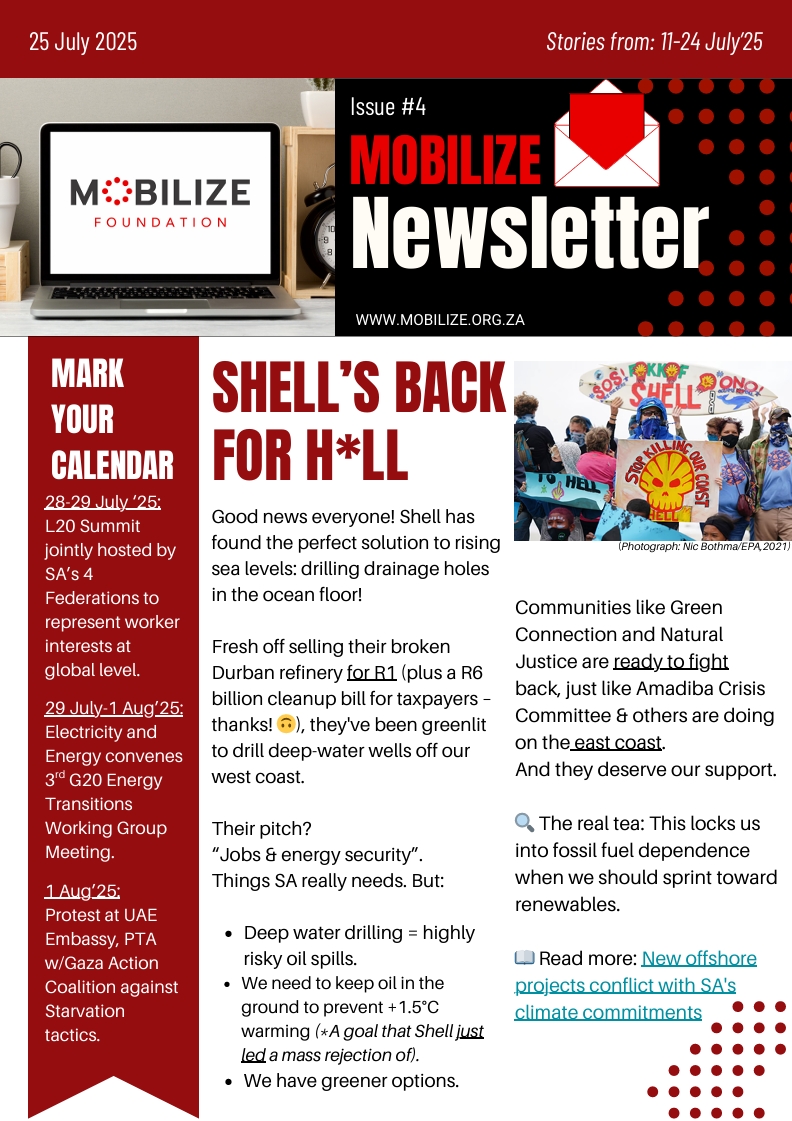
#4 of Mobilize Newsletter covers Shell’s controversial deep-water drilling plans off South Africa’s coast, and its impact on climate goals. This edition highlights South Africa’s draft emission reduction plan, debates on taxing the super-rich at the G20, and concerns over Joburg selling public green spaces. It also features a new climate study warning of just three years to act, youth-led victories like the #CancelCoal campaign, and a historic international court opinion on environmental rights. It promotes activist events, such as the We, the 99% People’s Summit, and offers ways for readers to get involved.
Source : Mobilize.org.za
NewsletterResources
Civic ParticipationClimate & Environmental JusticeClimate ChangeClimate Finance & ReparationsDemocracy, Governance & Civic ParticipationEconomic JusticeFossil Fuels & ExtractivismHuman Rights & Social JusticeJustice CampaignsLand, Housing & Indigenous JusticePollution & Environmental HealthUrban DevelopmentWealth & Corporate Tax Justice

#3 Mobilize Newsletter 25/07/2025
- Civic Participation, Climate & Environmental Justice, Climate Change, Climate Finance & Reparations, Democracy, Governance & Civic Participation, Economic Justice, Financial Justice & Reparations, Global South Solidarity, Just Transition, Peace, Conflict & International Solidarity
- Newsletter, Resources
#3 Mobilize Newsletter 25/07/2025
July 12, 2025
#3 Mobilize Newsletter 25/07/2025
#3 of the Mobilize Newsletter (12 July 2025) provides a roundup of key developments in climate justice, economic inequality, and political accountability in South Africa and globally. It covers concerns about “dirty climate money,” highlighting how funds for South Africa’s clean energy transition are being diverted to international consulting firms with fossil fuel ties. This edition also explores the role of the BRICS Summit in advancing a just energy transition, including support for green jobs and shifting global power dynamics. Additionally, the newsletter promotes policy and finance spaces, including G20-related meetings and a sustainability seminar in Johannesburg focused on green finance and collaboration.
Source : Mobilize Website
NewsletterResources
Civic ParticipationClimate & Environmental JusticeClimate ChangeClimate Finance & ReparationsDemocracy, Governance & Civic ParticipationEconomic JusticeFinancial Justice & ReparationsGlobal South SolidarityJust TransitionPeace, Conflict & International Solidarity
#2 Mobilize Newsletter 27/06/2025
- Civic Participation, Climate & Environmental Justice, Climate Change, Democracy, Governance & Civic Participation, Economic Justice, Financial Justice & Reparations, Food Justice & Hunger, Food Security & Sovereignty, Global Debt & Trade Justice, Government Accountability, Hunger & Malnutrition, Just Transition, Renewable Energy
- Newsletter, Resources
#2 Mobilize Newsletter 27/06/2025
June 27, 2025
#2 Mobilize Newsletter 27/06/2025
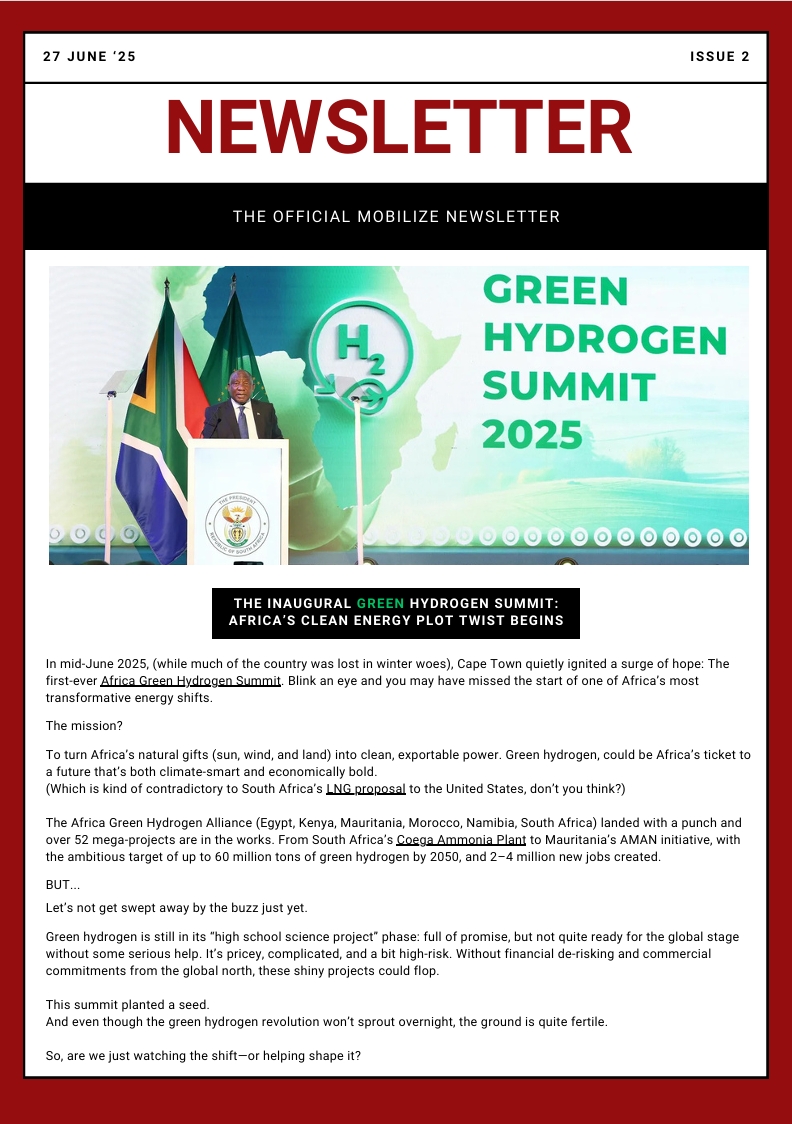
#2 of Mobilize Newsletter (27 June 2025) provides a roundup of key developments in climate justice, economic inequality, and political accountability in South Africa and globally. It covers the inaugural Africa Green Hydrogen Summit and its potential to drive a clean energy transition. It highlights G20-related developments, including the role of C20 in promoting people-led participation, calls for climate and debt justice for the Global South, and discussions around ecological debt. The newsletter also features grassroots and community-driven stories, such as a national school water testing initiative and the #EndHungerNow campaign, alongside updates on extreme weather linked to climate change, South Africa’s proposed LNG deal with the United States, and the country’s growing role in battery energy storage. It includes insights into accountability spaces like SAI20 and promotes events and opportunities for civic engagement.
Source : Mobilize Website
NewsletterResources
Civic ParticipationClimate & Environmental JusticeClimate ChangeDemocracy, Governance & Civic ParticipationEconomic JusticeFinancial Justice & ReparationsFood Justice & HungerFood Security & SovereigntyGlobal Debt & Trade JusticeGovernment AccountabilityHunger & MalnutritionJust TransitionRenewable Energy
#1 Mobilize Newsletter 12/06/2025
- Climate & Environmental Justice, Democracy, Governance & Civic Participation, Food Justice & Hunger, Food Prices & Affordability, Fossil Fuels & Extractivism, Government Accountability, Hunger & Malnutrition, Just Transition, Renewable Energy
- Newsletter, Resources
#1 Mobilize Newsletter 12/06/2025
June 13, 2025
#1 Mobilize Newsletter 12/06/2025
#1 of Mobilize Newsletter (12 June 2025) provides a roundup of key developments in climate justice, economic inequality, and political accountability in South Africa and globally. This edition covers South Africa’s proposed LNG deal with the United States and the risks of increased fossil fuel dependence. It highlights the #EndHungerNow campaign and community-led “Hunger Indabas” pushing for food affordability, as well as accountability processes like the SAI20 summit focused on climate spending and governance. The newsletter also explores South Africa’s growing role in battery energy storage and its positioning within the global clean energy transition.
Source : Mobilize Website
NewsletterResources
Climate & Environmental JusticeDemocracy, Governance & Civic ParticipationFood Justice & HungerFood Prices & AffordabilityFossil Fuels & ExtractivismGovernment AccountabilityHunger & MalnutritionJust TransitionRenewable Energy

Climate Comms Baseline Report
- Civic Participation, Climate & Environmental Justice, Climate Change, Climate Finance & Reparations, Democracy, Governance & Civic Participation, Just Transition
- Report, Resources
Climate Comms Baseline Report
January 1, 2025
Climate Comms Baseline Report
The Climate Comms Baseline Report 2025 establishes a baseline understanding of how partner organisations perceive climate justice, reparations, and adaptation needs, with the aim of strengthening climate communication and advocacy strategies.
Source : Mobilize Drive
ReportResources
Civic ParticipationClimate & Environmental JusticeClimate ChangeClimate Finance & ReparationsDemocracy, Governance & Civic ParticipationJust Transition
Exploring Community Experiences of Government’s Plans to solve the Energy Crisis
- Climate & Environmental Justice, Democracy, Governance & Civic Participation, Government Accountability, Just Transition
- Report, Resources
Exploring Community Experiences of Government’s Plans to solve the Energy Crisis
March 6, 2024
Exploring Community Experiences of Government’s Plans to solve the Energy Crisis
The March 2024 baseline report outlines how community-based research to understand public experiences of South Africa’s energy crisis, perceptions of government policies like the Energy Action Plan, and awareness of the Just Energy Transition.
ReportResources
Climate & Environmental JusticeDemocracy, Governance & Civic ParticipationGovernment AccountabilityJust Transition
Climate Comms Baseline Report: Navigating the Climate Crisis and Global Warming in South African Communities affected by Triple Threat Challenges.
- Civic Participation, Climate & Environmental Justice, Climate Change, Democracy, Governance & Civic Participation, Just Transition
- Report, Resources
Climate Comms Baseline Report: Navigating the Climate Crisis and Global Warming in South African Communities affected by Triple Threat Challenges.
February 16, 2024
Climate Comms Baseline Report: Navigating the Climate Crisis and Global Warming in South African Communities affected by Triple Threat Challenges.
This study will serve as a baseline to inform further interventions by Mobilize Agency that are aimed at addressing the climate crisis and to encourage community participation leading up to the upcoming G20 conferences in Brazil and South Africa respectively. This will be achieved by creating content that is easy to understand, to make it accessible to various members of society as far and wide as possible. Throughout, robust distribution and feedback systems will be developed and maintained to ensure maximum impact, reach and effect of the campaign.
ReportResources
Civic ParticipationClimate & Environmental JusticeClimate ChangeDemocracy, Governance & Civic ParticipationJust Transition
Energy Comms Pre and Post Survey Report on the Lived Realities of Coping with Loadshedding and Power Cuts in two South African Provinces
- Climate & Environmental Justice, Democracy, Governance & Civic Participation, Government Accountability, Just Transition, Service Delivery
- Report, Resources
Energy Comms Pre and Post Survey Report on the Lived Realities of Coping with Loadshedding and Power Cuts in two South African Provinces
November 1, 2023
Energy Comms Pre and Post Survey Report on the Lived Realities of Coping with Loadshedding and Power Cuts in two South African Provinces
This report (November 2023) analyses pre- and post-survey data from community participants to assess how their knowledge, attitudes, and perceptions of South Africa’s energy crisis evolved through engagement in the Energy Comms campaign. It focuses on understanding views on load-shedding causes, government plans like the Energy Action Plan and Just Transition, and community responses to energy challenges.
ReportResources
Climate & Environmental JusticeDemocracy, Governance & Civic ParticipationGovernment AccountabilityJust TransitionService Delivery
Community Perspectives of the Transition from Coal to Green Energy- “No one consulted us. They just do as they please”.
- Civic Participation, Climate & Environmental Justice, Democracy, Governance & Civic Participation, Fossil Fuels & Extractivism, Just Transition, Renewable Energy
- Report, Resources
Community Perspectives of the Transition from Coal to Green Energy- “No one consulted us. They just do as they please”.
October 6, 2023
Community Perspectives of the Transition from Coal to Green Energy- “No one consulted us. They just do as they please”.
The “Community Perspectives of the Transition from Coal to Green Energy” report (October 2023) examines how South African communities experience and understand the shift from coal to renewable energy.
Source : Mobilize Drive
ReportResources
Civic ParticipationClimate & Environmental JusticeDemocracy, Governance & Civic ParticipationFossil Fuels & ExtractivismJust TransitionRenewable Energy
Round 3: The Lived Realities of coping with loadshedding and power cuts in two South African Provinces- Community perceptions and voices on government plans to address loadshedding
- Climate & Environmental Justice, Democracy, Governance & Civic Participation, Government Accountability, Just Transition, Renewable Energy
- Report, Resources
Round 3: The Lived Realities of coping with loadshedding and power cuts in two South African Provinces- Community perceptions and voices on government plans to address loadshedding
August 1, 2023
Round 3: The Lived Realities of coping with loadshedding and power cuts in two South African Provinces- Community perceptions and voices on government plans to address loadshedding
This report (August 2023) builds on earlier rounds to examine how communities engage with and understand government energy plans, particularly the Energy Action Plan and Just Transition, while assessing access to information, trust in these policies, and the effectiveness of communication efforts.
Source : Mobilize Drive
ReportResources
Climate & Environmental JusticeDemocracy, Governance & Civic ParticipationGovernment AccountabilityJust TransitionRenewable Energy
Round 2: The Lived Realities of coping with loadshedding and power cuts in two South African Provinces
- Climate & Environmental Justice, Democracy, Governance & Civic Participation, Government Accountability, Just Transition, Renewable Energy, Service Delivery
- Report, Resources
Round 2: The Lived Realities of coping with loadshedding and power cuts in two South African Provinces
July 1, 2023
Round 2: The Lived Realities of coping with loadshedding and power cuts in two South African Provinces
This report (July 2023) examines how communities in Gauteng and KwaZulu-Natal cope with ongoing load-shedding, with a focus on illegal electricity connections, alternative energy use, and perceptions of government responses, aiming to deepen understanding of lived realities and inform communication and policy approaches.
Source : Mobilize Drive
ReportResources
Climate & Environmental JusticeDemocracy, Governance & Civic ParticipationGovernment AccountabilityJust TransitionRenewable EnergyService Delivery
Energy Comms Intervention Workshops’ Quantitative Survey Report
- Climate & Environmental Justice, Just Transition
- Report, Resources
Energy Comms Intervention Workshops’ Quantitative Survey Report
June 1, 2023
Energy Comms Intervention Workshops’ Quantitative Survey Report
This report explores community knowledge and perceptions of South Africa’s energy crisis.
ReportResources
Climate & Environmental JusticeJust Transition
Round 1: The Lived Reality of Daily Power Cuts in two South African Province
- Climate & Environmental Justice, Democracy, Governance & Civic Participation, Just Transition, Service Delivery
- Report, Resources
Round 1: The Lived Reality of Daily Power Cuts in two South African Province
May 1, 2023
Round 1: The Lived Reality of Daily Power Cuts in two South African Province
This report (May 2023) documents the lived experiences of communities in Gauteng and KwaZulu-Natal facing ongoing power cuts, aiming to understand how the energy crisis affects daily life and to inform more effective communication and policy responses through the Mobilize Energy Comms campaign.
Source : Energy Comms
ReportResources
Climate & Environmental JusticeDemocracy, Governance & Civic ParticipationJust TransitionService Delivery
Dr. T on Human Rights
- Access to Healthcare, Equality, Health Justice, Healthcare Workers, Human Rights, Human Rights & Social Justice, Human Rights Defenders, Public Health
- short form, Speech, Videos
Dr. T on Human Rights
March 12, 2026
Dr. T on Human Rights
Human rights are not optional. They are indivisible, unconditional, and a vital language of accountability. Health and care workers are defenders of human rights At the Human Rights Council’s 59th session, Tlaleng Mofokeng called for a global paradigm shift: health systems must be sustainable and equitable, and they must treat care workers with dignity. Read the full speech: https://www.youtube.com/watch?v=Ad9N-YlDTvk See more: https://www.youtube.com/@DrTlalengMofokengNetwork
Source : Youtube
short formSpeechVideos
Access to HealthcareEqualityHealth JusticeHealthcare WorkersHuman RightsHuman Rights & Social JusticeHuman Rights DefendersPublic Health
G20 Debt Relief Mural
- Economic Justice, Financial Justice & Reparations, Global Debt & Trade Justice
- Protest Video, short form, Videos
G20 Debt Relief Mural
January 6, 2026
G20 Debt Relief Mural
This activist street art reflects a global truth: when systems fail us, communities create their own power. It challenges the debt and housing crises shaping lives worldwide, This mural stands as a reminder that change is built through collective action and creative resistance.
Source : Youtube
Audience : G20 Protest
Protest Videoshort formVideos
Economic JusticeFinancial Justice & ReparationsGlobal Debt & Trade Justice
Historic Debt and the Climate Crises aren’t just Africa’s Burden
- Climate & Environmental Justice, Climate Change, Climate Finance & Reparations, Economic Justice, Financial Justice & Reparations, Global Debt & Trade Justice, Global South Solidarity, Peace, Conflict & International Solidarity
- Podcast, short form, Videos
Historic Debt and the Climate Crises aren’t just Africa’s Burden
December 22, 2025
Historic Debt and the Climate Crises aren’t just Africa’s Burden
From bold colours to the finest hand-drawn lines, this mural reflects a global truth: when systems fail us, communities create their own power. Each mark represents a voice challenging the debt and housing crises shaping people’s lives worldwide. Together, they form a reminder that change is built layer by layer through collective action and creative resistance
Source : Youtube
Podcastshort formVideos
Climate & Environmental JusticeClimate ChangeClimate Finance & ReparationsEconomic JusticeFinancial Justice & ReparationsGlobal Debt & Trade JusticeGlobal South SolidarityPeace, Conflict & International Solidarity
Africa’s wealth is being drained long before it can benefit its people
- Disability Rights, Economic Justice, Financial Justice & Reparations, Fossil Fuels & Extractivism, Gender-Based Violence, Global Debt & Trade Justice, Mining & Resource Justice, Municipality budgets and Finance, Wealth & Corporate Tax Justice
- Podcast, short form, Videos
Africa’s wealth is being drained long before it can benefit its people
December 16, 2025
Africa’s wealth is being drained long before it can benefit its people
Africa’s wealth is being drained long before it can benefit its people. Multinational corporations exploit loopholes while presenting polished “responsible” images. This isn’t about blaming citizens. It’s about exposing the systems and narratives that hide the real culprits. Transparency and accountability are key to a fairer future.
Source : Youtube
Podcastshort formVideos
Disability RightsEconomic JusticeFinancial Justice & ReparationsFossil Fuels & ExtractivismGender-Based ViolenceGlobal Debt & Trade JusticeMining & Resource JusticeMunicipality budgets and FinanceWealth & Corporate Tax Justice
Overconsumption isn’t just an environmental problem, it’s a social one too
- Climate & Environmental Justice, Climate Change, Education & Knowledge Justice, Pollution & Environmental Health, Public Education, Waste & Circular Economy
- Explainer Video, short form, Videos
Overconsumption isn’t just an environmental problem, it’s a social one too
November 2, 2025
Overconsumption isn’t just an environmental problem, it’s a social one too
Overconsumption isn’t just an environmental problem, it’s a social one too. In South Africa, a small portion of people use far more than needed, straining our planet and communities. Consume smarter: – Choose durable, high-quality clothes – Support local & sustainable brands – Reduce, reuse, recycle Small changes in daily life = a big impact for the planet and people.
Source : Youtube
Explainer Videoshort formVideos
Climate & Environmental JusticeClimate ChangeEducation & Knowledge JusticePollution & Environmental HealthPublic EducationWaste & Circular Economy
Is LNG a good thing?
- Climate & Environmental Justice, Climate Change, Fossil Fuels & Extractivism, Just Transition
- Podcast, Videos
Is LNG a good thing?
June 3, 2025
Is LNG a good thing?
On the Climate Comms Podcast, we’re joined by Lazola Kati, the powerhouse Campaign Coordinator behind Fossil Ad Ban, an initiative of @fossilfreesouthafrica142. We dive into how fossil fuel advertising shapes public opinion—and how activists like Lazola are fighting back to protect our planet.
Source : Youtube
PodcastVideos
Climate & Environmental JusticeClimate ChangeFossil Fuels & ExtractivismJust Transition
The importance of Indigenous Knowledge in climate change
- Biodiversity & Conservation, Climate & Environmental Justice, Climate Change, Education & Knowledge Justice, Indigenous Rights, Land, Housing & Indigenous Justice, Public Education, Traditional Knowledge
- Explainer Video, Videos
The importance of Indigenous Knowledge in climate change
May 7, 2025
The importance of Indigenous Knowledge in climate change
What if the key to fighting climate change has been here all along? Indigenous knowledge is a living force that can be used in the fight against climate change. How are we optimising the potential of these IKS tools? Find out how we’re tapping into it: https://www.journals.ac.za/sajhe/article/view/6417 (T.S. Madzivhandila)
Source : Youtube
Explainer VideoVideos
Biodiversity & ConservationClimate & Environmental JusticeClimate ChangeEducation & Knowledge JusticeIndigenous RightsLand, Housing & Indigenous JusticePublic EducationTraditional Knowledge
Africa is getting hotter
- Climate & Environmental Justice, Climate Change, Fossil Fuels & Extractivism, Just Transition
- Podcast, Videos
Africa is getting hotter
May 5, 2025
Africa is getting hotter
Does it ever feel like global warming hits us harder here? Well… It kinda does! Find out why that is and the effects of Spacial Apartheid on climate change from our interview with Fiona Anciano, on episode 1 of ‘Climate Comms: The Podcast’ now streaming.
Source : Youtube
PodcastVideos
Climate & Environmental JusticeClimate ChangeFossil Fuels & ExtractivismJust Transition
The Mobilize Podcast Ep.1: The HIDDEN COST of spatial apartheid
- Climate & Environmental Justice, Climate Change, Democracy, Governance & Civic Participation, Equality, Human Rights & Social Justice, Land, Housing & Indigenous Justice, Local Government, Pollution & Environmental Health, Service Delivery, Spatial Justice, Urban Development, Water Justice & Water Security
- Podcast, Videos
The Mobilize Podcast Ep.1: The HIDDEN COST of spatial apartheid
April 28, 2025
The Mobilize Podcast Ep.1: The HIDDEN COST of spatial apartheid
Professor Fiona Anciano in conversation with Koketso Sachane, unpacks how the legacy of spatial apartheid in South Africa continues to shape urban environments, and most critically, who bears the brunt of climate change. From segregated cities to unequal access to green spaces, flood protection, and clean air, the conversation not only revisits apartheid legacy and its impact, but how historical injustices intersect with today’s environmental challenges.
PodcastVideos
Climate & Environmental JusticeClimate ChangeDemocracy, Governance & Civic ParticipationEqualityHuman Rights & Social JusticeLand, Housing & Indigenous JusticeLocal GovernmentPollution & Environmental HealthService DeliverySpatial JusticeUrban DevelopmentWater Justice & Water Security
Mobilize: The Documentary
- Civic Participation, Civil Society, Climate & Environmental Justice, Democracy, Governance & Civic Participation, Health Justice, Human Rights, Human Rights & Social Justice, Pandemic Response
- Documentary, Videos
Mobilize: The Documentary
April 28, 2025
Mobilize: The Documentary
“Mobilize: The Documentary”, is a compelling story that chronicles the inspiring journey of a group of volunteers who, during the height of the COVID-19 pandemic, launched a grassroots communications effort to address critical information gaps. This initiative, called COVID Comms, has since evolved into Mobilize, a fully-fledged communications and mobilisation social enterprise, committed to providing accessible information on pressing social issues such as energy and climate change. “Mobilize: The Documentary” is a 76 Media production, in association with Mobilize Agency.
Source : YouTube
DocumentaryVideos
Civic ParticipationCivil SocietyClimate & Environmental JusticeDemocracy, Governance & Civic ParticipationHealth JusticeHuman RightsHuman Rights & Social JusticePandemic Response
South Africa’s future is at risk!
- Climate & Environmental Justice, Climate Change, Fossil Fuels & Extractivism, Just Transition
- Campaign, Videos
South Africa’s future is at risk!
April 26, 2025
South Africa’s future is at risk!
Did you know that major mining and energy business in South Africa are using the “just transition” to delay real climate action? @justsharesa gives a detailed account of how this has been happening and why it needs to be stopped. Read the report: https://justshare.org.za/wp-content/uploads/2025/05/JS-Lobbying-Report-Obstruction-Playbook-digital-1.pdf Watch the breakdown. Hold them accountable.
Source : Youtube
CampaignVideos
Climate & Environmental JusticeClimate ChangeFossil Fuels & ExtractivismJust Transition
The Mobilize Podcast Ep.8: The Case for Universal Basic Income in South Africa
- Economic Justice, Financial Justice & Reparations, Living Wages & Employment, Poverty & Inequality, Social Protection & Grants
- Podcast, Videos
The Mobilize Podcast Ep.8: The Case for Universal Basic Income in South Africa
June 19, 2024
The Mobilize Podcast Ep.8: The Case for Universal Basic Income in South Africa
In this episode, we cover: Why the Social Relief of Distress (SRD) grant isn’t enough, and who’s being left out What a Universal Basic Income could look like in South Africa How UBI could reduce poverty, boost the economy, and support a just transition Myths about “affordability” and why the real question is political will What it means to guarantee dignity and income security for all Learn more: What a South Africa with Basic Income Could Look Like: • A glimpse into a better future: A basic in… UBI Explainer Blog: https://iej.org.za/a-system-that-lift… SRD Court Case Statement & Policy Brief: https://iej.org.za/statement-historic… https://www.iej.org.za/wp-content/upl… UBI & Climate Factsheet: https://iej.org.za/ubig-factsheet-10_… Q&A with Siyanda on Basic Income: • Universal Basic Income – Q&A with IEJ’s Si…
Source : YouTube
PodcastVideos
Economic JusticeFinancial Justice & ReparationsLiving Wages & EmploymentPoverty & InequalitySocial Protection & Grants

Videos

Buzzword Breakdown: Historical Responsibility
- Climate & Environmental Justice, Climate Change, Climate Finance & Reparations, Economic Justice, Financial Justice & Reparations, Global South Solidarity, Peace, Conflict & International Solidarity, Poverty & Inequality, Wealth & Corporate Tax Justice
- Graphics, infographic
Buzzword Breakdown: Historical Responsibility


July 3, 2026
Buzzword Breakdown: Historical Responsibility
Historical Responsibility for the Climate Crisis A small number of industrialised countries are responsible for a disproportionate share of global greenhouse gas emissions, while the most severe impacts of climate change are felt by countries in the Global South. This imbalance does not stop at national borders, it also exists within societies. The wealthiest individuals are typically the highest emitters, through activities such as frequent private jet travel, luxury yachts, and investments in highly polluting industries. In stark numerical terms, the richest 1% of the global population is responsible for 16% of annual global emissions, the same amount produced by the poorest two-thirds of humanity, around 5 billion people (Oxfam). Learn more: https://ccpi.org/historical-responsibility-for-the-climate-crisis-the-roots-of-the-unfair-imbalance/
Source : Instagram
Graphicsinfographic
Climate & Environmental JusticeClimate ChangeClimate Finance & ReparationsEconomic JusticeFinancial Justice & ReparationsGlobal South SolidarityPeace, Conflict & International SolidarityPoverty & InequalityWealth & Corporate Tax Justice


Buzzword Breakdown: Maladaptation
- Climate & Environmental Justice, Climate Change, Climate Finance & Reparations
- Graphics, infographic
Buzzword Breakdown: Maladaptation


July 3, 2026
Buzzword Breakdown: Maladaptation
Maladaptation occurs when climate responses increase vulnerability, shift risks onto others, or create long-term environmental or social harm. Different types of maladaptation exist such as ‘rebound vulnerability’ which is a situation whereby the vulnerability of the intended target is increased rather than reduced. Maladaptation can also shift vulnerability so that it increases elsewhere or in the future. Eroding sustainable development by increasing greenhouse gas emissions, for example, is a type of maladaptation, too. Learn more: https://climatalk.org/2024/06/02/what-is-maladaptation/
Source : Instagram
Graphicsinfographic
Climate & Environmental JusticeClimate ChangeClimate Finance & Reparations

Know your rights. Show up
- Civic Participation, Community Dialogues and Meetings, Democracy, Governance & Civic Participation, Government Accountability, Local Government, Transparency
- Graphics, infographic
Know your rights. Show up


June 30, 2026
Know your rights. Show up
Democracy doesn’t end at the ballot box. It lives in our communities. Know your rights. Show up to IDP and budget meetings. Follow the money. Ask the hard questions. Organise with your community and speak up when things aren’t right. Demand transparency. Monitor delivery. Hold councillors and officials accountable when they fail to serve the people. Stay informed. Stay involved. Stay vocal.
Source : Instagram
Graphicsinfographic
Civic ParticipationCommunity Dialogues and MeetingsDemocracy, Governance & Civic ParticipationGovernment AccountabilityLocal GovernmentTransparency

South Africa’s inequality has a history
- Graphics
South Africa’s inequality has a history


June 19, 2026
South Africa’s inequality has a history
South Africa’s problems are real. Unemployment, crime, inequality, corruption, and failing public services affect millions. But targeting migrants will not solve these problems… they are structural and long-standing. South Africa’s inequality didn’t happen by accident; it was engineered. From the 1913 Natives Land Act to apartheid’s deliberate exclusion of Black people from land, wealth, and opportunity, the crisis we face today is structural. Swipe to understand the history, and join Kopanang Africa Against Xenophobia – KAAX to organise for real change.
Source : Facebook
Graphics

How to hold corporations accountable
- Activism, Civic Participation, Civil Society, Climate & Environmental Justice, Democracy, Governance & Civic Participation, Environmental Governance & Litigation, Government Accountability, Human Rights & Social Justice, Justice Campaigns, Transparency
- Graphics, infographic
How to hold corporations accountable
April 17, 2026
How to hold corporations accountable
Holding corporations accountable for the climate crisis isn’t just for activists; it’s something all of us can be part of. Start by staying informed and supporting research that exposes harmful environmental practices. Use your voice by signing petitions, contacting decision-makers, and backing campaigns that demand transparency and responsibility. Peaceful protest remains a powerful way to show public pressure, and when that’s not enough, litigation is an important tool to force accountability through the courts. From community action to legal challenges, real change happens when people consistently push for it. The more informed, organised, and persistent we are, the harder it becomes for corporations to ignore their responsibility.
Source : Instagram
Graphicsinfographic
ActivismCivic ParticipationCivil SocietyClimate & Environmental JusticeDemocracy, Governance & Civic ParticipationEnvironmental Governance & LitigationGovernment AccountabilityHuman Rights & Social JusticeJustice CampaignsTransparency

Buzzword Breakdown: Climate Finance
- Graphics
Buzzword Breakdown: Climate Finance


April 15, 2026
Buzzword Breakdown: Climate Finance
Climate finance includes public and private funding for mitigation, adaptation, and Loss and Damage, particularly to support developing countries and vulnerable communities. In a world where those who’ve contributed least to the climate crisis are often hit hardest, climate finance is a critical tool for fairness. It helps communities rebuild after disasters, adapt to a changing climate, and shift toward cleaner, safer futures. Learn more: https://www.lse.ac.uk/granthaminstitute/explainers/what-is-climate-finance-and-where-will-it-come-from/ 5d
Source : Instagram
Graphics
